It all begins with survival, and with meeting the population’s most basic need: food. Maize (Zea Mays), native to the Americas, reached the Iberian Peninsula in the 16th century, but its spread and large-scale cultivation in Portugal only came in the century that followed. The Minho region, with its geo-climatic conditions and its commitment to irrigated farming, was a pioneer in adopting it. The crop thrived quickly in north-western Portugal. Before that, the staple cereal feeding the population was millet (foxtail millet) and other cereals such as rye and wheat.
The introduction of maize brought about a true "agricultural revolution" in north-west Portugal. This cereal had a shorter growing cycle, greater productive potential and the ability to coexist with other crops (such as beans and pumpkin in a polyculture system). Its large-scale adoption profoundly changed the agrarian landscape, eating habits (maize cornbread became dominant) and the social and economic organisation of the Minho region.
The earlier crops were basically rain-fed, which allowed them to be grown on fairly steep terrain. The terraces (socalcos) emerged to make the steep slopes of the Minho productive, controlling erosion and the abundant water in this region.
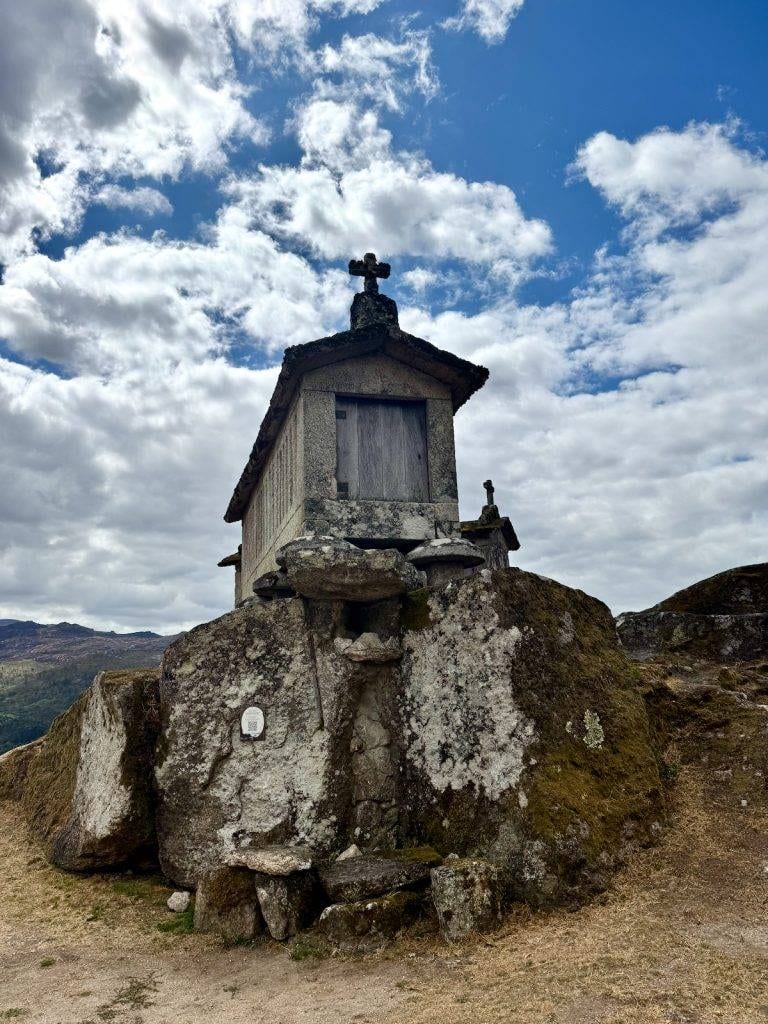
Maize, beyond human food (cornbread production), was used to feed animals, and the straw had multiple uses, such as filling pillows and mattresses. The new crop enabled a significant increase in population and dietary diversification, transforming the Minho landscape into a mosaic of maize fields alongside the espigueiros (granaries) used for drying and storing it.
The value of maize was so great that, beyond the espigueiros’ architectural protection (such as raising them off the ground and the round stone discs to keep rodents out), local people attributed to them a sacred character and divine protection, as seen in the stone crosses atop the granaries, especially in the monumental clusters of Soajo and Lindoso.
These crosses were meant to invoke divine protection over the stored grain, which often represented the community’s only means of survival throughout the year. Many espigueiros were (and are) for communal use, located on shared threshing grounds. This arrangement reinforced the idea of an essential good that needed collective and mystical safeguarding, beyond physical security.
Espigueiros and terraces are interconnected elements of Minho’s rural architecture, symbolising self-sufficiency and agricultural organisation, with the terraces producing the grain that the granaries stored, preserving the harvest for winter.
You are invited to relive this historical intensity at Carvalha House, in complete comfort, in the Carvalha Espigueiro accommodation, where you can share good moments alongside that symbolic element and a story so real, holding such rich heritage of this region.